

Buy Raw Honey
The 2025 harvest is called Grandma’s Reserve, named in honor of my first grandchild born in October. It is a special blend of my 2024–2025 vintages, all from the Holland terroir of my forest.
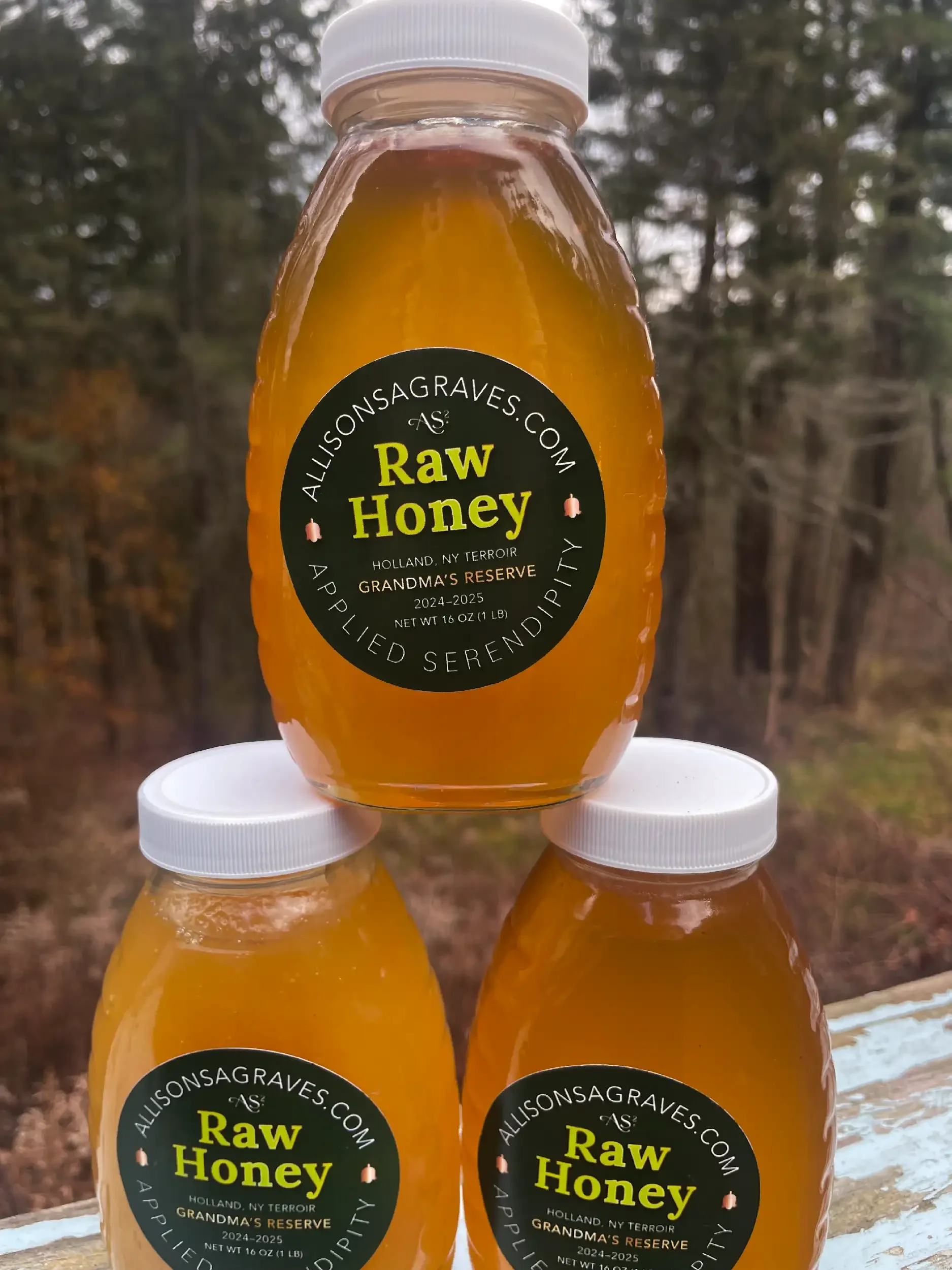
2025 Honey Release: Grandma’s Reserve
QUANTITIES ARE LIMITED
The 2025 blend is naturally thicker, richer, and more prone to crystallization than pure summer honey. Many of my customers actually prefer it for the depth and texture it brings.
Over the years, my honey has traveled in surprising ways. It has been used in clinical trials, served in fine restaurants, and even included in NASA experiments. Provenance matters, and this honey carries its own story.
This year, my honey is also available at Holland Hardware—one of my very favorite stores. All proceeds from these sales go directly to the Rural Outreach Center, supporting families and children in our region. If you’d like to order directly from me, please reach out.
About Our Honey
Please note: raw honey should not be given to infants under one year of age.
Our honey comes straight from the hives. We remove the frames, spin the honeycomb in an extractor, and strain it through a simple sieve. It is not heated or treated in any way. What ends up in the jar is exactly what the bees made for themselves. You may occasionally see a tiny speck that slipped through the sieve—just a trace of natural hive life.
Our honey goes from hive to table, carrying the light, the weather, and the wildness of my Holland forest in every jar.

About Beekeeping
I became a beekeeper in 2019 after we bought a cabin in the woods south of Buffalo. I started with two hives and now have four in my sustainable small-scale apiary. It was Applied Serendipity that I met my honey mentor Jamie Carney, a Certified Master Beekeeper, who has been the co-pilot in my beekeeping journey.
Beekeeping is hard work, particularly in Western New York, and it’s an emotional rollercoaster getting the colonies through long Buffalo winters. From November to March, the bees stay in the hives in a cluster formation, only coming out on occasional warm days. We have to be sure to leave plenty of honey in the hives to sustain them through winter, as well as manage moisture levels and control mites—one of the main reasons for colony collapse. Beekeeping is a commitment and a responsibility and not for the faint of heart. Yet it’s very rewarding and has brought me much more in touch with the cycles of nature.
-
From the American Bee Journal:
The honey bee is the only insect that produces food eaten by man.
A honey bee can fly for up to six miles, and as fast as 15 miles per hour, hence it would have to fly around 90,000 miles -three times around the globe – to make one pound of honey.
It takes one ounce of honey to fuel a bee’s flight around the world.
Bees maintain a temperature of 92-93 degrees Fahrenheit in their central brood nest regardless of whether the outside temperature is 110 or -40 degrees.
A populous colony may contain 40,000 to 60,000 bees during the late spring or early summer.
The queen bee lives for about 2-3 years. She is the busiest in the summer months, when the hive needs to be at its maximum strength, and lays up to 2,500 eggs a day.
The queen may mate with up to 17 drones over a 1-2 day period of mating.
The queen may lay 600-800 or even 1,500 eggs each day during her 3 or 4 year lifetime. This daily egg production may equal her own weight. She is constantly fed and groomed by attendant worker bees.
Worker honey bees live for about 4 weeks in the spring or summer but up to 6 months during the winter.
The average honey bee will actually make only one twelfth of a teaspoon of honey in its lifetime.
Honey bees fly at up to 15 miles per hour
The honey bee’s wings stroke 11,400 times per minute, thus making their distinctive buzz.
A honey bee visits 50 to 100 flowers during a collection trip.
Honey bees, scientifically also known as Apis Mellifera, are environmentally friendly and are vital as pollinators
Fermented honey, known as Mead, is the most ancient fermented beverage. The term “honey moon” originated with the Norse practice of consuming large quantities of Mead during the first month of a marriage.


Love for My Hive
The best honey I have ever tasted!
I love your honey!
I’ll never buy honey from the store again.
Thank your bees!
I ran out of your delicious honey… I need more for my tea!
The best honey I have ever had. Let me know when the next harvest is ready!
Hive to table desserts
We’re proud to partner with restaurants including Anton’s at the Swan for hive-to-table desserts. This cheesecake with Applied Serendipity Raw Honey drizzle was made by my brother-in-law and Chef Chris Connors. Chris opened his restaurant in Lambertville, NJ in 2001 because of its proximity to so many local farms. He’s been doing farm-to-table since before it was cool!
